Today, Uzbekistan’s livestock sector faces significant challenges, including global climate change, the need for rational use of natural resources, and the adoption of sustainable development principles. To support initiatives in this field, the “Livestock Sector Sustainable Development Financing Project” is being implemented for the 2022–2026 period with the support of the French Development Agency (AFD).
Over the five-year period, the project aims to develop the country’s livestock sector into a more sustainable, climate-resilient, and environmentally beneficial industry. Although the project covers all regions of Uzbekistan, special priority is given to areas such as Kashkadarya, Samarkand, Jizzakh, Surkhandarya, and the Republic of Karakalpakstan, where efficient use of natural resources is crucial and the impacts of climate change are more strongly felt.
“Green” livestock— an environmental and economic necessity
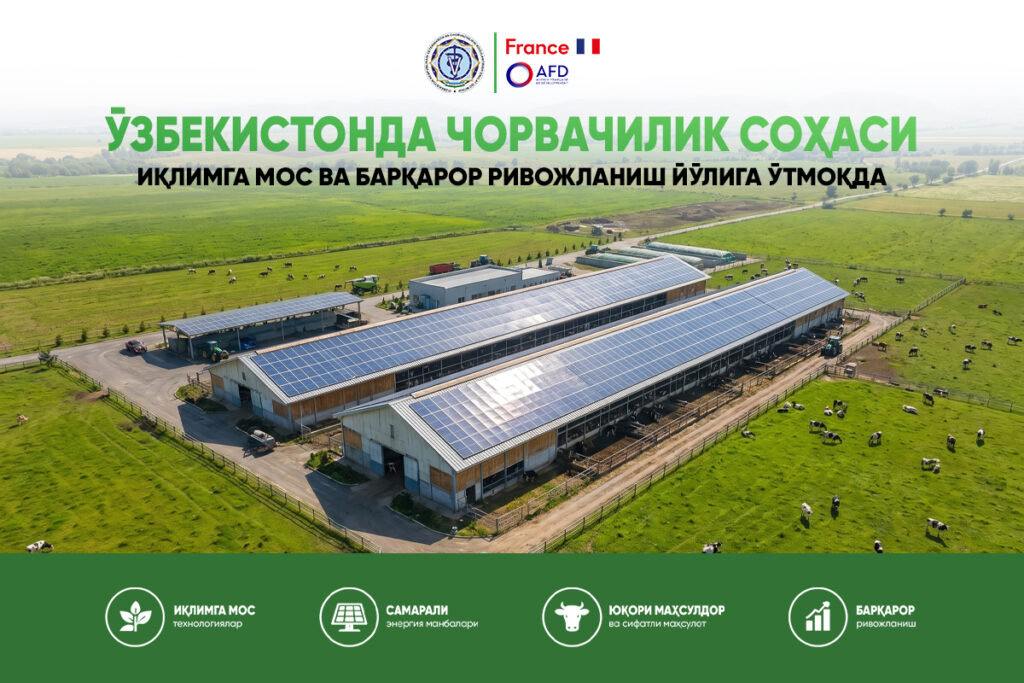
Maintaining traditional livestock farming methods today may lead to risks such as water scarcity and declining productivity. Therefore, the transition to green livestock farming has become not only an environmental priority but also an urgent economic necessity. The project aims to address issues such as low productivity, outdated technologies, and inefficient use of pastures. To achieve this, modern eco-technologies such as sustainable pasture management, water-saving systems, and biogas facilities are being systematically introduced at farms.
“In the current conditions, transitioning from traditional livestock farming to green models is the only way to preserve farmers’ future income and resources. We are not only protecting nature but also laying the foundation for competitive products in international markets”, said Grant program coordinator Jorabek Norkulov.
Financial support and practical results
Although the transition to environmentally friendly practices requires certain investments from farmers, within the project framework the financial burden is significantly reduced through concessional loans, state guarantees, and subsidies. The introduction of AFD standards increases product quality and safety to international levels. This expands export opportunities for local producers and strengthens the confidence of international investors. Practical results are already visible: improved feed systems and genetic selection have increased milk and meat productivity, climate-resilient livestock breeds are being developed, and herd quality is improving. Most importantly, livestock mortality has decreased, and farmers’ incomes are steadily growing.
Innovation and future outlook
Training of local specialists and farmers is a key element in the implementation of innovative approaches. This process is carried out through trainings, seminars, and demonstration farms, with active involvement of international experts. As farmers increasingly see real economic benefits and practical results, they are adopting new approaches more quickly and with greater interest. The project enhances the sector’s resilience to extreme heat and climate change by introducing climate-adapted technologies, including heat-resistant breeds, water-saving methods, and diversification of feed resources.
“We envision an ideal farm as a highly efficient system equipped with modern technologies and digital management tools, using resources efficiently and fully meeting environmental standards. We believe that in ten years, Uzbekistan’s livestock sector will become exactly such a sustainable and competitive system,” said Grant program coordinator Jorabek Norkulov.
In the future, the ideal livestock farm in Uzbekistan is expected to be resource-efficient, highly productive, and fully integrated into the market. These initiatives will not only help prevent shortages of meat and dairy products but will also place the entire sector on a sustainable development path in the era of climate change.