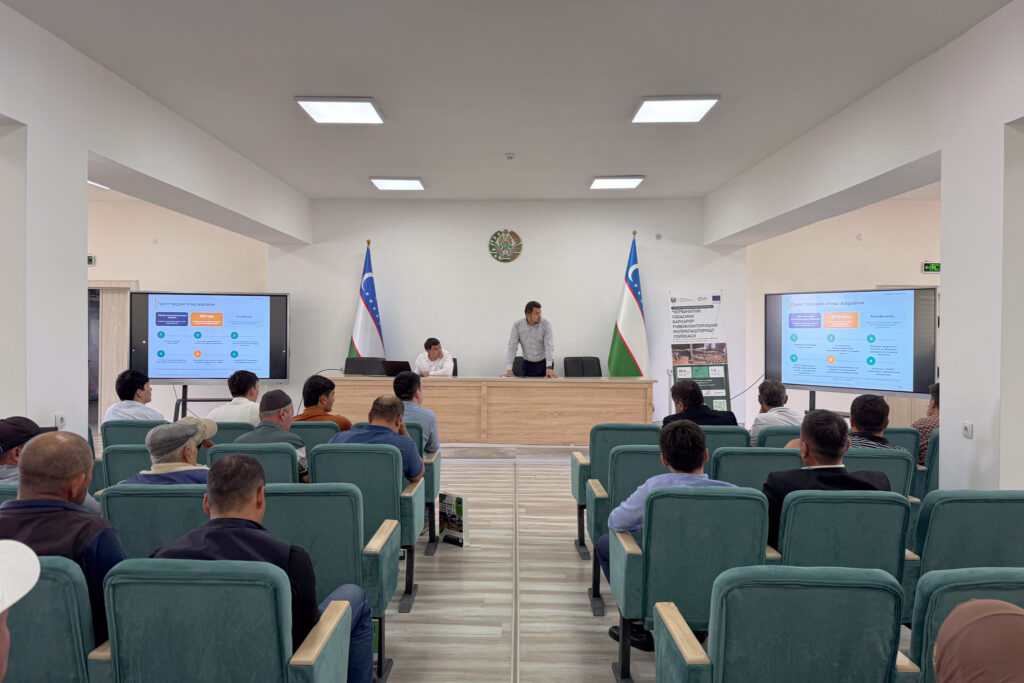
On September 28, a seminar was held at the Republican Center for Agricultural Services (AKIS) under the National Center for Knowledge and Innovation in Agriculture in Tashkent Region as part of the “Financing Sustainable Development of the Livestock Sector” project, implemented with the participation of the French Development Agency (AFD). Participants received detailed information on the loan application procedure, financing terms, grant eligibility criteria, and the purposes for which the funds can be used.
As noted at the seminar, a major financial program is being launched in Uzbekistan for farmers and entrepreneurs engaged in livestock farming. Under the program, small farms can obtain loans of up to 100,000 euros, while medium-sized and large businesses can receive up to 1 million euros. The key benefit is that for climate-smart projects that meet the relevant requirements, up to 40% of the loan may be covered by a European Union grant.
According to Jurabek Narkulov, the project’s grant coordinator, financing will be provided through two channels. Medium-sized and large farms will be eligible for loans of up to 1 million euros, while small farmers and entrepreneurs can obtain loans of up to 100,000 euros.
“Loan funds can be used to purchase modern equipment, expand production capacity, develop feed production, and process agricultural products,” said Jurabek Narkulov.
The first credit line, intended for medium-sized and large farms, amounts to 65.9 million euros in total. Under this facility, loans of up to 1 million euros can be provided for a single project. Investment loans are available for up to 10 years, with a grace period of up to three years. Working capital loans are provided for up to 18 months, with a grace period of up to nine months.
At the same time, entrepreneurs are required to finance at least 30% of the total project cost from their own funds.
A separate credit line has been established for small farmers and dehkan farms, household plot owners, family businesses, limited liability companies, individual entrepreneurs, cooperatives, and processing enterprises. Loans of up to 100,000 euros are available under this facility.
At least 24 million euros is planned to be allocated under this credit line. The European Union will provide 7.7 million euros for grant programs. Most importantly, for projects that meet the relevant requirements and contribute to climate change adaptation or the reduction of environmental impact, up to 40% of the loan may be covered by grant funding.
However, the grant is not provided directly to the entrepreneur or simultaneously with the loan. Applicants must meet a number of requirements to qualify. In particular, the entrepreneur must have no overdue loan debt, the loan funds must be used for their designated purposes, and all purchases made must be supported by the relevant documentation.
Grants will not be available in certain cases. For example, if the loan is used entirely as working capital, if the project does not meet climate-smart requirements, or if the funds are used to purchase cattle or small ruminants, the borrower will not be eligible for grant funding.
The project covers several areas of livestock farming. Business projects in cattle farming, sheep farming, rabbit farming, poultry farming, beekeeping, and fish farming may be eligible for financing.
Loans will also be provided for strengthening the feed base, introducing energy-efficient technologies, purchasing modern production equipment, and processing milk and other livestock products.
A separate 13.5 million euros fund is planned to finance cattle imports. This funding will be available to farms with more than 50 head of cattle.
Approved projects will be financed through Xalq banki, Microcreditbank, Business Development Bank, and Hamkorbank.
According to the available information, the total value of the “Financing Sustainable Development of the Livestock Sector” project for 2022–2026 amounts to 147 million euros. The French Development Agency is providing 100 million euros, while the European Union is providing 11.5 million euros in grants.
Experts note that these financial mechanisms may help farmers increase production capacity, introduce modern technologies, expand processing chains, and increase opportunities for producing competitive livestock products. In particular, the mechanism allowing part of the loan to be covered by a grant is expected to provide an additional incentive for small farms to implement investment projects.