Sustainable livestock farming is a model of agricultural management focused on long-term development without harming the environment, the economy, or society. This approach is supported by the French Development Agency (AFD), which considers sustainability a core principle in project planning and financing. It involves not only farm modernization but also the creation of a more responsible and balanced production system.
Sustainable livestock farming includes:
• reducing environmental impact and using natural resources efficiently;
• ensuring the economic viability of farms;
• complying with social standards and promoting animal welfare;
• implementing modern management technologies;
• aligning with international sustainable development principles.
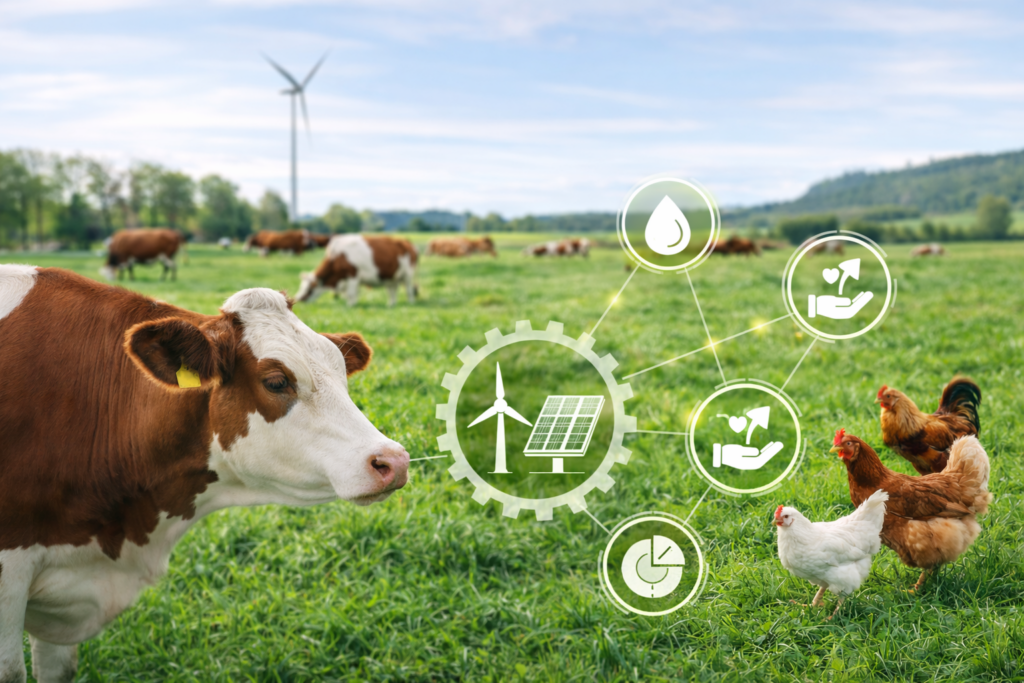
Environmental sustainability involves reducing greenhouse gas emissions, managing manure effectively, conserving water, and protecting soil from degradation. An important role is played by the introduction of biogas facilities, solar panels, and energy-efficient equipment. These solutions help lower costs while minimizing environmental impact.
The economic component means that a farm can operate and grow steadily without constant external support. This is achieved through sound business planning, digital livestock management, optimized feed rations, and expansion into new markets.
The social aspect includes job creation, decent working conditions, and the development of rural areas. Special attention is given to animal welfare — ensuring proper nutrition, veterinary care, and comfortable living conditions.
Thus, sustainable livestock farming integrates environmental responsibility, economic efficiency, and social stability, forming the foundation for the long-term development of the sector and strengthening food security.